Biography: Altius Architecture Inc.

Early Life & Formation

Altius Architecture Inc. is a Toronto-based firm, founded in the late 1990s initially as Altius Design Studio, and then incorporated formally. The founding partners met as students at the University of Waterloo’s School of Architecture. Over time, Altius established a reputation for designing custom homes, cottages, and interiors with strong attention to sustainability, materiality, and regional context.

Key People & Style

One of the leading figures at Altius is Cathy Garrido, who is a Managing Principal and one of the founders. She holds a Bachelor of Architecture from Waterloo, is LEED accredited, and is involved in both residential and interior design work. Another partner, Mike Lanctot, handles many of the project management and BIM (Building Information Modelling) roles.

The firm’s style combines modern and contemporary aesthetics with careful craftsmanship and sustainable design practices. Their homes often make use of honest, expressive materials, good daylighting, and spatial layouts that balance comfort and light. Altius works on custom homes, cottages (“lake cottages”), as well as urban residences, and places importance on energy performance (such as LEED and Passive House elements) in certain projects.

Notable Projects & Local Work

  • Altius has completed a variety of custom homes and cottages across Ontario. Examples include Lakeview in the Beach, Don Mills House, Mimico Creek Residence, and other custom residences in both urban and rural settings.

  • Their portfolio also includes work on interior spaces and commercial/residential mixed projects.

Their architect is popular in the Greater Toronto Area (GTA) and extends into the Durham Region (Ajax and Pickering) and beyond.

Why Their Work Matters

Altius is significant because:

  • They represent a generation of architects in Ontario who combine design excellence with sustainable and environmental awareness.

  • Their work tends to be client-centered: tailoring homes to how people actually live, not just making a showpiece.

  • They also engage with new technologies (like BIM) and contemporary building practices, which helps ensure that the homes are efficient, durable, and in many cases more cost-efficient over the long term.


Practical Note for Homebuyers

Even when buying a home designed by a well-regarded architect like Altius (or anyone), one should still get a professional home inspection in Ajax prior to purchase. Beautiful architecture and good design don’t automatically guarantee that everything—from structure and insulation to wiring and plumbing—is in perfect shape. An inspection helps uncover hidden defects or maintenance issues, and gives you peace of mind that you're making a sound investment.
Biography: Atelier SUN / Andrew Sun

Early Life & Philosophy

Atelier SUN is a Toronto-based multi-disciplinary design studio founded by Andrew Sun. Sun’s studio works at the intersection of architecture, interior design, and furniture, and places a high value on storytelling, materiality, spatial sequence, and the emotional impact of spaces. The studio draws from both Canadian and Asian design influences, aiming for designs that are familiar yet unexpected.

Notable Works

  • The Courtyard House in East York, Toronto: a new detached house characterized by a central, double-height courtyard. It uses natural materials, generous windows/skylight, and integrates outdoor/indoor light and space in creative ways.

  • Harty House, Ajax, Ontario: This is a renovation of an ordinary 1980s “builder home” into a calmer, more minimal, and more refined dwelling. The project incorporates wood millwork, clean spatial reorganizations, floating stairs, subtle finishes, and a careful handling of excessive structural elements in the original house to make them feel part of the design rather than impediments.

Significance & Style

Atelier SUN is part of a recent wave of design firms that focus on renovation / adaptive reuse, interior architecture, and bespoke residences. Their approach emphasizes craftsmanship, material detail, light, and transforming existing homes to better suit how people live now, rather than always building new. They are noted for aesthetic restraint, clarity of space, and sensitivity to context.


Why Buyers Should Inspect Any Home, Even Architect-Designed Ones

Even when a home has beautiful design, high end finishes, or comes from a well-known architect or design studio, there can still be hidden issues — with structure, wiring, plumbing, insulation, etc. Before buying any home, especially those with renovations or custom features, it's wise to get a professional home inspection in Ajax Ontario to uncover any problems that might be costly later. That protects your investment and ensures you’re getting not just beauty, but safety and functionality too.

Biography of Ron Thom (1923–1986)

Ron Thom was one of Canada’s most influential architects of the 20th century, known for his ability to merge modernist principles with warmth and livability in residential design. Born in Penticton, British Columbia, in 1923, Thom originally trained as a painter at the Vancouver School of Art before transitioning to architecture. This artistic background deeply informed his architectural style, giving his buildings a sculptural and expressive quality.

Thom began his career at the Vancouver firm Thompson, Berwick, and Pratt, where he quickly made a name for himself. His early residential projects helped establish the West Coast Modern movement, which emphasized natural materials, open interiors, and a deep respect for the surrounding environment.

One of his most admired works is the Copp House (1950s) in Vancouver, designed with dramatic use of wood, stone, and large windows to frame views of nature. His residential designs often combined comfort and artistry, balancing modernist geometry with organic warmth. Unlike many modernists who favored stark minimalism, Thom’s homes were richly textured, with fireplaces, wood paneling, and thoughtful detailing that made them both elegant and inviting.

Beyond homes, Thom also designed significant cultural and educational landmarks, including Trent University in Peterborough, Ontario (1964–1973), and Massey College at the University of Toronto (1963). These projects cemented his reputation as an architect who could blend form, function, and artistry.

Thom’s life was not without struggles—he was known for being both brilliant and temperamental—but his influence on Canadian architecture remains profound. His work demonstrated that modernism could be warm, human, and deeply connected to place.

For today’s homebuyers considering a Thom-designed house—or any architecturally significant residence—it’s important to remember that even great design needs practical assurance. A professional home inspection is an essential step before purchase, ensuring that hidden structural or mechanical issues don’t undermine the beauty and value of the property.

Ron Thom’s legacy lives on in the unique homes and institutions he created, as well as in the generations of architects inspired by his fusion of artistry and architecture.

Biography of Arthur Erickson (1924–2009)

Arthur Erickson was one of Canada’s most celebrated architects, renowned for his innovative and distinctly modernist approach to design. Born in Vancouver, British Columbia, in 1924, Erickson grew up surrounded by the dramatic landscapes of the West Coast, which later influenced his architectural philosophy. After serving in World War II, he studied architecture at McGill University in Montreal, graduating in 1950.

Erickson’s work is internationally recognized, but in Canada he is especially remembered for his contributions to residential architecture. He designed homes that harmonized with the natural environment, often incorporating large windows, open floor plans, and seamless transitions between indoor and outdoor spaces. One of his most famous residential works is the Eppich House II (1988) in West Vancouver, a striking example of steel-and-glass design set against the lush coastal rainforest. Earlier, his Smith House (1964) on the Vancouver waterfront became a hallmark of West Coast Modernism, with its clean lines and panoramic views of the Pacific.

While Erickson also worked on large-scale projects such as Simon Fraser University (1963–1965) and the Canadian Embassy in Washington, D.C. (1989), his residential designs are beloved for their ability to reflect both the individuality of the homeowner and the beauty of the Canadian landscape.

Beyond his architectural achievements, Erickson was also a teacher, mentor, and advocate for modern Canadian design. His career, however, was not without challenges, including financial difficulties in the later years of his practice. Still, his legacy endures in the form of iconic homes, public buildings, and a generation of architects influenced by his vision.

For homebuyers inspired by Erickson’s residential works—or by any notable architect’s designs—it is important to remember that even a masterpiece should be carefully assessed before purchase. A professional home inspection ensures that structural, electrical, and mechanical systems are sound, protecting both the investment and the homeowner’s peace of mind.

Arthur Erickson remains a towering figure in Canadian architecture, his designs continuing to shape the way Canadians think about living spaces that are both modern and deeply connected to their surroundings.

Artist Biography: Vincent van Gogh


Vincent Willem van Gogh was a Dutch post-impressionist painter whose extraordinary talent and tumultuous life have left an indelible mark on the art world and art history. Van Gogh's expressive style, characterized by bold colors, dynamic brushwork, and emotional intensity, has made him one of the most influential figures in Western art history. Despite his tragic and misunderstood existence, his artistic contributions continue to inspire and resonate with audiences worldwide.

Early Life and Background: Vincent van Gogh was born on March 30, 1853, in Groot-Zundert, a small village in the Netherlands. He came from a family of art dealers, and although he initially worked in the art trade, Van Gogh's true passion lay in creating art rather than selling it. His early works were influenced by Dutch Realism and the somber palette of artists such as Jean-François Millet.

Artistic Journey and Development: Van Gogh's artistic journey began in earnest when he decided to pursue a career as an artist in his late twenties. He studied briefly at the Royal Academy of Fine Arts in Antwerp and later joined the artist colony in Paris, where he was exposed to various art movements, including Impressionism and Japanese prints, which greatly influenced his evolving style.

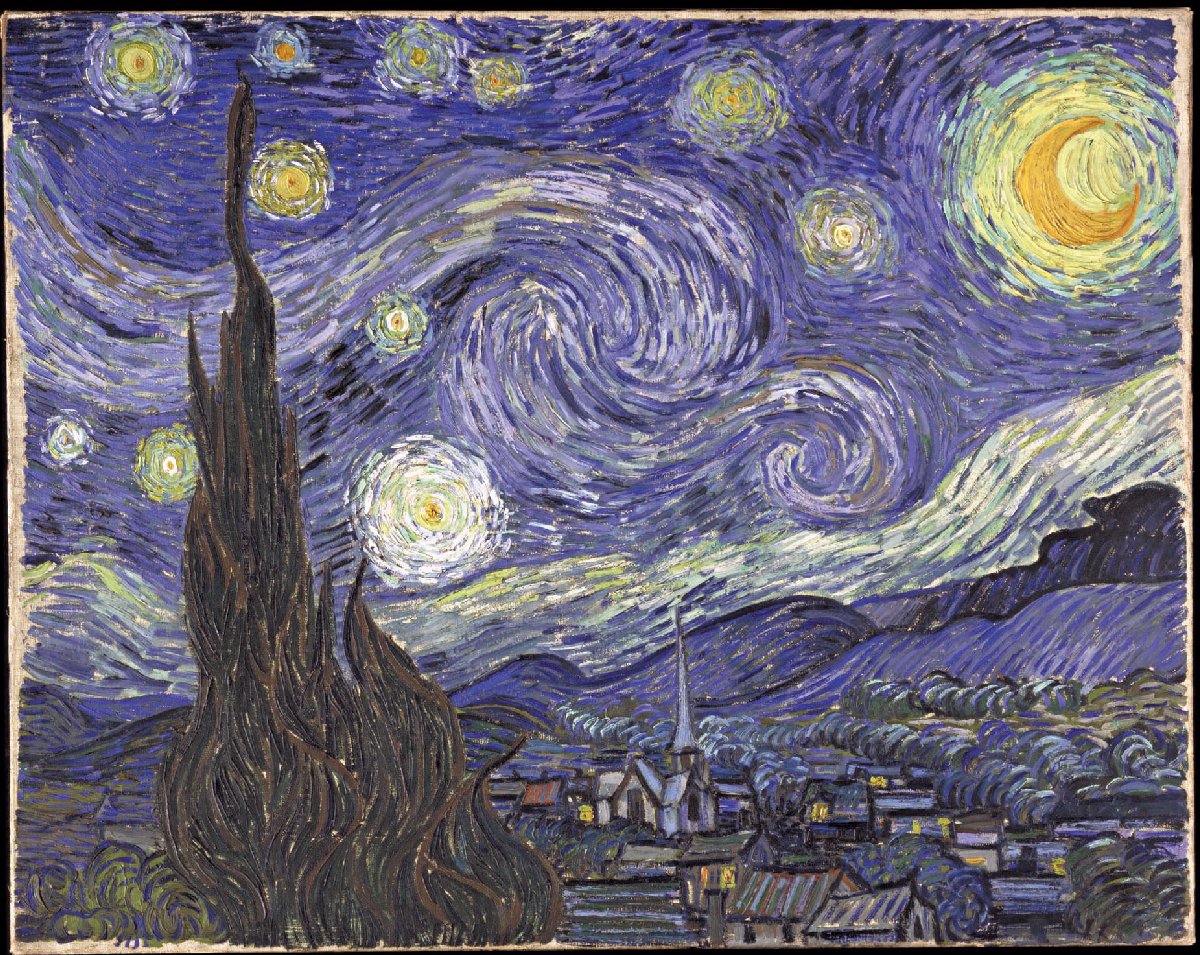
During his time in Paris, van Gogh's palette shifted to brighter and more vibrant hues, and his brushwork became increasingly expressive and energetic. His iconic works from this period, such as "The Starry Night" and "Sunflowers," showcase his unique ability to capture the emotional essence of his subjects through dynamic color combinations and vigorous brushstrokes.

Personal Struggles and Mental Health: Van Gogh's artistic brilliance was often overshadowed by his personal struggles and battles with mental health. He suffered from recurrent episodes of anxiety, depression, and psychosis, which had a profound impact on his life and art. Despite these challenges, his periods of stability were marked by immense productivity and artistic growth.

In 1888, van Gogh experienced a mental breakdown and severed his own earlobe, an event that later became the subject of much speculation and fascination. He voluntarily admitted himself to psychiatric institutions, where he continued to produce a remarkable body of work, including his introspective self-portraits and landscapes.

Legacy and Impact: Tragically, Vincent van Gogh's brilliance was not fully recognized during his lifetime. He struggled with poverty, rejection, and a lack of understanding from the art establishment. It was only after his death in 1890, at the age of 37, that his art began to gain appreciation and acclaim.

Van Gogh's legacy has since become synonymous with the power of artistic expression and the resilience of the human spirit. His art continues to inspire countless artists, art lovers, and individuals worldwide, who find solace and beauty in his vivid landscapes, poignant portraits, and heartfelt self-reflections.

Today, Van Gogh's works are celebrated in major art museums and galleries around the world, with his iconic paintings fetching record-breaking prices at auctions. His profound impact on the art world and his ability to convey profound emotion through his art have secured his position as one of the most beloved and influential artists of all time.

Vincent van Gogh's life may have been plagued by personal challenges, but his artistic genius and unique vision have transcended time and continue to touch the hearts and minds of people across the globe. His bold and evocative style, coupled with his relentless pursuit of emotional truth, have cemented his status as an icon of art history. Van Gogh's legacy serves as a reminder that true artistic expression often springs from deep wells of passion, struggle, and resilience.

A+ Art History Topics for Essay Writing

Art history essays topics that could get you that 'A+'

You should not have to cheat or hire an essay writing company in Toronto in order to get an A+ on your art history essay. There are plenty of topics that can earn you an A or A+ without having to resort to hiring someone else to write you an amazing essay. Do the honest work, put in some serious effort and your professor will know you did it yourself.

Art history is a vast and complex subject. It could take you from the architectural feats of Frank Lloyd Wright which include the Guggenheim Museum to the primitive cave drawings of Lascaux, France. This can make picking your topic a tough decision since there is so much to choose from. What should you do to ensure that you get the grade you want? Here are some tips to help you with your decision making.

Pick a topic that reflects what you have learned.

If you are in a Baroque period class don't start talking about modern architecture as that will be way off topic. Pick a style, artist or feature that fits into that particular period. So for instance you should talk about the use of movement in Baroque paintings, sculpture and architecture. Or you can talk about how Baroque artists were fascinated with the play of lights and darks in their work. If you want to reference another style or period that is not pertinent to the one you are learning ask your teaching first. Also, try to include non-relevant styles and periods so that they in contrast with the period that you are currently learning. For instance, to use the Baroque period as an example, you could contrast it with the previous Renaissance period and their different use of movement, lights and darks, realism and proportion.

Choose a topic that you like.

You will have to write a long (5-20 pages) essay so do not pick a topic you do not find interesting. Pick a topic that you feel connected to and that piques your interest. You could try to find a topic that you want to learn about beyond what you have learned in class. Or you may want to pick a topic that you already have learned about previously and you found interesting. Either way try to ensure that what you are writing about is at least somewhat interesting to you so that you do not feel like it is a chore to write.

Choose a topic that has a lot of scholarly literature about it.

Try to pick a topic that has already been well researched. If you pick an obscure topic you may find it difficult to find materials that will help you support your art history essay. Also, using 1 or 2 books in your bibliography will not make your essay very well researched and it definitely will not get you the 'A+" you want so try to find a topic that has more scholarly muscles behind it. You can use your textbook to start your search for a more prominent topic as textbook usually talk about the subjects most important topics. From there you can continue your research online or in the library where you will be sure to find more information about your chosen topic.

The key to a great any essay is to be clear and concise and the first step to doing that is to get a firm grasp on what your topic is. Your art history essay will be greatly improved if you follow the steps listed above and get an air tight topic to writ about.


Victoria Van Dyke


Victoria Van Dyke is a lesbian feminist artist living in Canada who uses mostly photography and collage in her works.

Born in 1976, Van Dyke was raped when she was eleven years old by her foster father and foster brother. The burden of her traumatic memories has caused her to create what some might call highly disturbing art pieces. She frequently discusses the idea of cannibalism, and has openly claimed that she herself was a cannibal. She commonly uses cannibalism as a metaphor for evil within modern society, such as businessmen eating each other and eating the poor in order to make themselves fat/rich. She often titles her work with numbers and uses models, claiming she dislikes her own body.

She spent over three years in a mental asylum, where she placed herself voluntarily. She was finally released in the Spring of 2005. She currently lives in Toronto, Canada. Most recently, she made the news for chopping off her little toe, putting it in a jar and offering it to a gallery as a work of art. The gallery - which preferred to be unnamed - refused, and called the police.

She combines religion, violence, guns, sexuality and humour in images (sometimes with text) in order to poke fun at society, society's obsession with sex, and the patriarchal treatment of young underage women as sex objects.

 The artist admits a strong thirst to eat the flesh of humans, but objects to the immorality of killing.

Pablo Picasso

Pablo (Ruiz y) Picasso
Birth Year : 1881
Death Year : 1973
Country : Spain

Pablo Ruiz Picasso was born in Malaga, Spain. The son of a Basque art teacher, Picasso showed a very early talent for drawing. He was fourteen when the family moved to Barcelona where his father was a professor at the School of Art. Two years later Picasso had his first exhibition of rather somber, quite classical paintings. Between 1900 and 1904 he made three trips to Paris where he studied the works of the Impressionists and of Cezanne. In 1904 he settled in France, where he has remained all his life. From 1901 onwards, Picasso's work may be divided into periods, each showing different influences and personal interests. From 1901 to 1904, the Blue Period, his paintings were melancholy in mood and subject matter, flat of form and strong contour, nearly monochromatic, and of intense blue. In some of these works, the Mannerist influence of El Greco is easily visible. The Rose Period (1905-06) offers the same flat forms but with a softer contour, a more romantic mood, and a delicate ink tonality that is often used with the blue of the earlier works. In 1906 Picasso met Matisse, with whom he shared an interest in the works of Gauguin and Cezanne. At the time he also was influenced by African primitive carvings, the result was the masterpiece Les Demoiselles d'Avignon, a huge painting of five nudes and a small still life, angularly distorted, with strong, barbaric forms that seem flat but are actually so shaded as to be three-dimensional. Called Cubism by the critics, its translucent, blocky planes led to the Analytical Cubism practiced by Braque and Picasso from 1909 to 1911 in which familiar objects such as glasses and pitchers were broken down into geometric planes. From about 1912 to 1915, the collage or paste-up method of Synthetic Cubism was developed in which bits of cloth or paper were used to build up an image. From 1915 until 1936, Picasso painted in various Cubist manners, experimented with Surrealism, and entered his classical (sometimes called white) period in the early 1920's, producing works that are sculpturesque and yet tender in mood. In the 1930's he was working in a Cubist style that is metamorphic in its visual approach. The tragic masterpiece Guernica (1937) is painted in this style. It is a work of monumental grandeur with a tragic, almost vocal effect upon the viewer. The double portraits that first appeared in 1938 are a further evolution of this metamorphic style. In 1948 Picasso returned to themes of women, children, animals, and birds, painting in various manners synthesizing all of his previous styles. He has also produced lithographs and etchings on classical and literary subjects, sculpture, murals, jewelry, and ceramic works. Picasso's palette is varied, but he may, at times, limit himself to tones of gray and black, as in Guernica, or to a favorite combination of black, white, and shades of ochre. Picasso exhibits in his work both an attachment to the past and an innovating spirit, a spontaneity and a sense of justice. His enormous talent, imagination, and vitality add up to an artistic temperament that can be called genius. Picasso's influence upon modern art has been immeasurable.

Jackson Pollock

Jackson Pollock
Birth Year : 1912
Death Year : 1956
Country : US

Jackson Pollock, who was born in Cody, Wyoming, lived in Arizona and California until 1929. He took his first lessons in art at the Manual Arts High School in Los Angeles. Pollock came to New York to study at the Art Students League and worked under Thomas Hart Benton during the years 1929 to 1931. He began his career as an artist during the depression years and worked for the Federal Arts Project in New York from 1938 to 1942. He then moved to Huntington, Long Island. Pollock's early painting was expressionistically realistic and then surrealistic in style. However, by the early 1940's his work had become completely abstract expressionist in character with no figuration at all. This was an expression of the isolation of the painter in the modern world: painting itself is the subject matter of these works, a concept that must be accepted by the viewer before he can begin to understand or appreciate this highly intellectual form of art. In 1951-52 Pollock reintroduced the semblance of anatomical imagery into his abstract work. Pollock's art was a violent, romantic revolt in which the artist himself was irrevocably involved, for he was completely committed to the act of painting in itself, to the possibilities inherent in paint, and to the results of the interactions between himself and his medium. When he flung his paint at the canvas, he energetically directed it, fought with it, and either won or lost the battle. The result is a painting that moves dynamically in all directions, from the inner to the outer surface. A freedom of expression resulted that revolutionized mid-twentieth-century art both in the United States and in Europe, creating a new expansion and a new impetus for the solution, through art, of modern man's struggle in the modern world. Pollock's career was tragically cut short by his death in an automobile accident.

Grant Wood

Grant Wood

Birth Year : 1892
Death Year : 1942
Country : US

Grant Wood, an American painter, was a leader in the art movement known as Regionalism, which also included the artist Thomas Hart Benton. Wood was born in Iowa and lived mainly in Cedar Rapids. He visited Europe repeatedly from an early age and studied at the Academie Julian in Paris in 1933. Still, he was mainly self-taught as an artist: he worked as a camouflage painter during World War One, an interior decorator, and a metalworker. His early paintings were strongly influenced by French Impressionism. In 1928, having been commissioned to make stained-glass windows for the Cedar Rapids Veterans Memorial Building, he traveled to Munich to supervise the windows' production; there he encountered early Dutch painting, and was inspired to give up Impressionism in favor of his characteristic mature style. Under the influence of Memling and other early Netherlandish masters, Wood began painting with close attention to sharp, crisp detail. In the Regionalist aesthetic, the everyday lives of working people are the highest subjects of art; modern ideas of abstraction are often considered elitist and decadent. Wood therefore mainly depicted scenes of everyday Midwestern life in a fresh and sometimes stark manner. His best-known work, American Gothic (1930), won a bronze medal at an exhibition at the Art Institute of Chicago, but it caused controversy among some of the very people it was intended to depict, who interpreted the painting as broad, insensitive caricature. In the decades since, however, the work has become one of the most enduring images in American art. Wood painted many landscapes, as well as other scenes and portraits, including The Midnight Ride of Paul Revere (1931) and a genuinely satirical work, Daughters of the Revolution (1932). He supervised Federal Art Projects in Iowa and was assistant professor of fine arts at the University of Iowa.

Edgar Degas

Edgar Degas
Birth Year : 1834
Death Year : 1917
Country : France

Edgar Degas, an Impressionist more interested in movement than in color, was born in Paris, the son of a banker who wished him to go into business. Degas, therefore, did not begin to study art until he was twenty-one. He studied the work of Clouet and Poussin at the Louvre, and after a year, he went to Italy and studied the art of the Middle Ages and of the Renaissance. His greatest early admiration was for Ingres and until he met Manet and the Impressionists, Degas painted quite classical historical works. Once Degas joined the Impressionists, Degas changed his subject matter, painting racetrack scenes sketched from life and finished in his studio, theatrical and ballet scenes, and many pictures of women. He worked in many different mediums and concentrated upon the portrayal of movement that hints toward the action immediately preceding and immediately following that of the moment captured by his rapid pencil or brush.

His skill as a draughtsman was extraordinary and his paintings have the feeling of immediacy that is usually associated with the camera. Degas also discarded classical rules of composition and frequently used an oblique angle with light coming from below to create a new type of theatrically focused space. In his oils, he applied his color in translucent cross-hatching and for his pastels used a technique in which color was applied in many successive layers, each layer except the last fixed to give a powdery, soft effect that was particularly effective in his ballet scenes. Stories of Degas' sharp tongue and crustiness abound-he was a solitary misogynist-but his personality is of little importance in comparison to his art. His hundreds of dancers-in oils, pastels, tempera, gouache, charcoal, pencil and bronze-are revelations of human movement; his horses seem alive; and his studies of women at work, bathing, or in cafes, have a sense of reality that is both emotional and intellectual.

Jacques-Louis David

Jacques-Louis David

Birth Year : 1748
Death Year : 1825
Country : France

Jacques Louis David was born in Paris and first studied with Francois Boucher, whose influence may be seen in his works until 1770. In 1768, however, David had begun his studies with the Neoclassicist Joseph Marie Vien. A two-time winner of the Prix de Rome, David did not go to Italy until 1775. He remained for five years, studying the works of Caravaggio and other seventeenth-century Italian Baroque artists. David attracted much attention in Rome for the realistic vigor of his series of strong portraits. He became more and more deeply involved, while in Rome, in the Neoclassical aesthetics of Vien, Anton Raphael Mengs, Johann Winckelmann, and Benjamin West. David studied antique sculpture and ancient history and began to choose his subjects from the latter. The work that became the manifesto of Neoclassicism, the "Oath of the Horatii", was painted in 1784-85, on a second visit to Rome. In this and in his next great work, "The Death of Socrates", painted in Paris with figures inspired by classical statues and compositions taken from Roman bas-reliefs, David added two Caravaggiesque touches: sharp lighting that casts clear shadows, and realistic detail. David's art, embodying the ancient civic virtues, became the symbol of the Revolution and its aesthetic doctrines.

David was also active in the political side of the French Revolution where, from about 1787, he was the arbiter of taste and design in furniture, clothing, and the stage, as actors began to pose in groups similar to those in his paintings. He brought about the downfall of the French Royal Academy, thus freeing artists from its narrow tradition. He taught more than sixty pupils and was imitated by scores of artists. In 1793 David painted the realistic "Death of Marat", a powerful painting closer to the sensibilities of a Caravaggio than to those of antique sculpture. In 1794, while briefly imprisoned, he did a naturalistic landscape view of the Luxembourg Gardens. An enthusiastic Bonapartist, David became the first painter to the Emperor, an officer in the Legion of Honor, and a member of the Institute. With the restoration of the Bourbons, however, he was banished to Belgium for having voted for the death of Louis XVI and it was there that he died. David's strong sculptural painting had replaced the delicate and artificial style of the eighteenth century. Although his strict classicism held back the rise of the Romantic School, he stimulated such artists as Gros and Géricault in their free choice of subjects and in their passionate seriousness. He was thus an important force in the evolution of modern painting.

Salvador Dali

Salvador Dali
Birth Year : 1904
Death Year : 1989
Country : Spain

Salvador Dali was born in Figueras, Spain, the son of a notary whose family came from Cadaques on the Costa Brava. The Dali family spent their summers in Cadaques, and it is this landscape that appears over and over in the artist's work, either as background or as an integral part of the composition. Dali began his career as an enfant terrible in the schools of Figueras and then went to the School of Fine Arts in Madrid where he quickly learned the fundamentals of drawing. At this time, however, he was more interested in studying Freud and art magazines that specialized in Cubism, Futurism, and metaphysical art. In about 1928, he went to Paris, attached himself with passionate conviction to the French Surrealists and soon married Gala Eluard, former wife of the poet Paul Eluard, one of the founders of the movement. However, as Dali became absorbed in the study of Italian Renaissance painters, the French Surrealists rejected his style as too academic in technique and, thus, he left France for New York.

Dali's work is distinguished by precise and finely executed draughtsmanship of almost photographic exactitude. Paint is applied smoothly and evenly in a varied and generally muted palette that occasionally breaks out into glaring color. His subject matter is that of the Freudian dream world and of metamorphosis of objects, people, and animals, arranged in unexpected and often inexplicable combinations. A prodigious worker, Dali has produced large quantities of paintings that include portraits, landscapes with figures, figures seemingly superimposed on landscapes, and, more recently, religious subjects. He has also done illustrations for books, lithographs and etchings, and jewelry designs.

Gustave Courbet

Gustave Courbet
Birth Year : 1819
Death Year : 1877
Country : France

Gustave Courbet was born in Ornans in the Franche-Comté, the son of a comfortable family that was half peasant, half bourgeois, and very proud of its revolutionary ancestry. Courbet, a handsome young man, went to Paris in 1840 to study art, taking almost no instruction but working in the Louvre and from models. He began as a Romantic, seeing himself in early self-portraits as a rather Byronic figure. The Revolution of 1848 swept away the last vestiges of Courbet's romantic tendencies and he became a realist. As such, he was able to paint only what he saw in the world around him and the simple life of plain people. By 1849 such naturalistic works as The Stone Breakers (destroyed in 1945 in the bombing of Dresden) indicated by their subject matter and treatment that he had answered Baudelaire's plea for paintings that expressed "the heroism of modern life."

Courbet's own life was fairly heroic: as an artist, he was both greatly admired and greatly detested. As a man, he was imprisoned for his part in the Commune uprising of 1871, spent six months in prison, and then went to live in exile in Switzerland where he died, still owing the French government a large sum charged to him for the destruction of the Vendome column. Throughout his life he fought with both government authorities and public taste but continued to paint as he pleased, for as Ingres said of him in 1849 "he is an eye."

Courbet responded in his paintings to the world in which he was brought up: people, animals both wild and tame, fruits and flowers, landscapes, and seascapes. His palette, at first dark or restrained, became warmer and brighter as he grew older. A master of technique, he could apply paint as smoothly as enamel or in thick corrugations. His ability to paint texture, particularly that of animal pelts, was matchless. His fruits are round and full, bursting with sweetness; his flowers delicately differentiated; his landscapes forceful. Courbet brought life to inanimate objects, love and understanding to human beings.

John Constable

John Constable
Birth Year : 1776
Death Year : 1837
Country : United Kingdom

John Constable was the son of a miller in Suffolk, England. Though Sir George Beaumont introduced him to the work of Claude Lorrain, Constable painted sketched by himself until he was twenty-four, when he entered the Royal Academy School in London. Constable believed that landscape painting must strive to include "a pure apprehension of natural effect" and he painted typical scenes from the southern English countryside. He worked with watercolors and directly from the motif while outdoors, then enlarged his sketches in oil once indoors. These landscapes differ from those of his predecessors because of Constable's primary concern with light, air, and sky rather than with exact landscape details. He considered the sky "the key-note ... and chief organ of sentiment," and delighted in registering its changes and in using it as a foil for the more stable land. As a result, he developed a broad, free technique that gives his work a particularly romantic softness.

Although he was the first to treat landscapes with spontaneity and emotion, his first exhibition in 1802 passed almost unnoticed since the demand in England was for portraits. In fact, for years, Constable painted portraits, for which he cared little, in order to earn his meager living, while he continued to paint the landscapes in which his real interest lay. When he was forty-eight, he sent several landscapes to the Paris Salon. The French were highly impressed and awarded him the Gold Medal (1824) for "The Hay Wain". Even so, it was only five years later that Constable was elected, with full membership, to the Royal Academy. Nevertheless, Constable considered this honor as having come too late, and he lived out his last years lonely and embittered. Complete recognition of his talents and his technique of using broken touches of color to convey movement and light did not come until after his death.

Thomas Cole

Thomas Cole
Birth Year : 1801
Death Year : 1848
Country : US

Thomas Cole, outstanding Hudson River landscapist, was born in Lancashire, England. He was apprenticed to a textile designer and engraver before immigrating, with this family, to Philadelphia in 1819. In Philadelphia, he added the technique of wood engraving to his repetoire. When the Cole family moved to Stuebenville, Ohio Thomas made a short voyage to the West Indies before joining them. In Ohio, he became an itinerant portrait painter for some years and then returned to study at the Pennsylvania Academy of Fine Arts where he was most influenced by the landscapes of Thomas Birch and Thomas Doughty. In 1825 Cole moved to New York City, spent a summer roaming around the Catskills, and made his debut as a landscapist. His work was markedly romantic yet minutely exact, dramatic yet scrupulously naturalistic in composition and leaned heavily toward the unspoiled, primeval aspects of nature. Three of his first paintings were purchased by well-known artists, which helped establish his reputation rapidly. Cole began to spend more and more time in the mountains and along the shores of the Hudson River, but when he decided to go to Europe in 1829, the poet William Cullen Bryant exhorted him in a sonnet to "keep that earlier, wilder image bright."

In Europe, Cole discovered J.M.W. Turner, Raphael, and Claude Lorrain during his visit to London, Paris, Florence and Rome. After his return to America in 1832 he began to combine his knowledge of European art with his natural impulse to portray nature as he saw it. He painted series of enormous allegorical significance: "The Course of Empire" (1836) and "The Voyage of Life" (1839), are good examples of these. They were reproduced as engravings and they sold very well, providing him with the means to return to Rome in 1841 where he closed himself off from the world to paint a second version of "The Voyage of Life". The work was badly received in Rome and Cole returned to his family, to the home he had established in Catskill-on-Hudson, and to his beloved mountains. He was ill, depressed, and tortured, and spent the remainder of his life painting the romantic, realistic landscapes that are his greatest works. With their striking contrasts of light and shade, their inherent feeling of God's presence in nature, their exquisitely fine detail and warm color, they are the keystone of American landscape painting-honest, moving, and beautiful.

Judy Chicago

Judy Chicago
Birth Year : 1939
Death Year :
Country : US

Born Judy Cohen in Chicago, Illinois, Judy Chicago is a sculptor, painter, and multimedia artist who has worked mainly in California. Her work has been closely associated with a phase of the feminist movement that began having a powerful impact on both American and global culture in the 1970's. From 1960 to 1964, she studied at the University of California at Los Angeles. At Fresno, she helped launch the first feminist art course in the United States. Along with Miriam Schapiro, Chicago co-founded the influential Feminist Art Program at the California Institute of the Arts at Valencia. Chicago has been interested in revisiting the aesthetic and practical techniques with which women have traditionally been associated - weaving, quilting, needlework, etc. - with the intention of freeing these from such dismissive categories as "folk art" and "craft," which diminish their power and importance.

"Collaboration" is an essential element in many such traditionally feminine arts, and it has played an important role in Chicago's work. For example, her "The Dinner Party" installation (1974-1979) of a triangular banquet table, 48 feet long on each side, with 39 place settings, invited the contribution of many women artists. Each of these settings represented the contributions to the history of Western civilization of a number of important women, either historical or mythical. The table, moreover, stood on a large tile floor, and inscribed on each tile were the names of other important women. The installation traveled widely, sparking lively debate about feminist art. In more recent works, Chicago has explored similar feminist issues, and in 1980, in collaboration with her husband Donald Woodman, she began working on "The Holocaust Project", completed in 1993, which featured a collection of art objects exploring the significance of the Holocaust in the context of the traditionally feminine sensibilities of compassion and care. Other works include "The Birth Project" (1985) and "Through the Flower: My Struggle as a Woman Artist" (1975).

Paul Cezanne

Paul Cezanne
Birth Year : 1839
Death Year : 1906
Country : France

Paul Cezanne, the greatest Post-Impressionist master, was born in Aix-en Provence where he received his formal education as a classmate of Emile Zola. Cezanne, whose banker father wished him to study law, did not arrive in Paris until 1861 although he had studied drawing in Aix and showed considerable ability. While studying at the Académie Suisse, Cezanne met Pissarro who was to influence him greatly. When he failed the entrance examinations for the Beaux-Arts, however, he returned to Aix. After working for a year in his father's bank and painting only in his spare time, he returned to Paris (1862-64). Zola introduced him to Manet, Renoir, Bazille and Degas, and Cezanne worked fairly loosely with these artists. Between 1864 and 1890 Cezanne lived in Paris, its environs and in the region around Aix until diabetes forced him to retire permanently to Aix. Early in his career, Cezanne admired Caravaggio, Courbet, and Delacroix, and his paintings until 1868 were romantic or baroque in style, dark in color, and classical in subject. During the period 1868-72 Manet's influence may be noted in added clarity and solidity of form. During his Impressionist period (1872-79) his palette lightened and, following Pissarro's example, he approached nature with greater simplicity.

Throughout the years that he exhibited with the Impressionists Cézanne held the unhappy distinction of being the most derided member of the group. He liked his own work no better than the critics and public did, however, but in 1880 he began to develop his own theory of painting and his own style. It is a style characterized by unemotional, non-narrative, closed compositions that are based on the reduction of every object in nature to the cone, the cylinder, or the cube - those permanent qualities, which he believed were beneath all accidental external variations. He achieved a three-dimensional architectural effect by deliberately alternating warm and cool tones, by using a dark outline around objects and forms, and by an intensely dynamic balancing of shapes. None of Cézanne's works are the result of accident. He painted and repainted, altered brushstrokes attacked his subjects from different angles, and deliberately falsified perspective to achieve a timeless landscape, an orderly intelligence, and a solidity of form.

All modern art can be said to stem, either directly or indirectly, from Cézanne: Symbolism, Fauvism, Cubism, Expressionism, and Abstract Expressionism. He immediately affected the work of Gauguin, van Gogh, Picasso, and Braque who, in turn, have influenced countless others. Cézanne finally began to receive some public recognition in 1895 and for the remaining eleven years of his life he enjoyed both public and private attention. He continued to paint until six days before he died of pneumonia on October 22, 1906.

Mary Cassatt

Mary Cassatt
Birth Year : 1845
Death Year : 1927
Country : US

Mary Cassatt, one of the two women and the only American to show with the Impressionists, was born in Pittsburgh. She was the daughter of a millionaire and spent her childhood in Europe with her family. When the Cassatt's returned to live in Philadelphia, Mary studied at the Pennsylvania Academy of Art until she was twenty-three. Then, against her father's wishes, she left for Europe to study further and visit Italy, Spain, and Belgium before going to Paris where, as she said, the sight of a pastel by Degas changed her life. It was through Degas, who was more her sponsor than her teacher, that she delighted to be relieved of the arbitrary standards established for acceptance at the official Salons. Cassatt scrupulously separated her social life from her artistic one and was in some ways aloof from the relaxed artistic atmosphere around her.

Her subject matter was thus restricted to the ladylike pastimes and scenes with which she was generally surrounded, but her technique and power were by no means limited. She was a fine artist in her favorite mediums: oil, pastel, etching, and lithography. Her work has the intellectualized emotion of Degas; the soft contours of Renoir, (particularly in her many renderings of children and mothers), and the flat surface of Manet. In addition, she was strongly influenced by Japanese prints and she was extremely adept at handling large color masses while she achieved the Oriental quality of cleanliness with a sure and incisive draughtsmanship. By far the wealthiest and the most financially influential of the Impressionists, Cassett did a great deal, unobtrusively, to help her associates. Not only did she purchase many of their works for herself, but she also encouraged her friends, the Havemeyers and the Stillmans, to collect Impressionist art and, when conditions were desperate, she even loaned money to the Durand-Ruel Gallery to promote an exhibition. Cassatt, who received very little recognition in her own country until long after her death, lived and worked in France throughout her life and was awarded the French Legion of Honor in 1904.

Michelangelo Merisi da Caravaggio

Michelangelo Merisi da Caravaggio
Birth Year : 1573
Death Year : 1609
Country : Italy

Michelangelo Merisi da Caravaggio, revolutionary naturalist painter, was born in Caravaggio near Milan, the son of a mason. He showed his talent early and at the age of sixteen, after a brief apprenticeship in Milan, he was studying with d'Arpino in Rome.

During the period 1592-98 Caravaggio's work was precise in contour, brightly colored, and sculpturesque in form, like the Mannerists, but with an added social and moral consciousness. By 1600 when he had completed his first public commission the St. Matthew paintings for the church of San Luigi dei Francesi, he had established himself as an opponent of both classicism and intellectual Mannerism.

Caravaggio chose his models from the common people and set them in ordinary surroundings, yet managed to lose neither poetry nor deep spiritual feeling. His use of chiaroscuro - the contrast of light and dark to create atmosphere, drama, and emotion - was revolutionary. His light is unreal, comes from outside the painting, and creates deep relief and dark shadow. The resulting paintings are as exciting in their effect upon the senses as on the intellect.

Caravaggio's art, strangely enough, was not popular with ordinary people who saw in it a lack of reverence. It was highly appreciated by artists of his time and has become recognized through the centuries for its profoundly religious nature as well as for the new techniques that had changed the art of painting.

Though Caravaggio received many commissions for religious paintings during his short life, he led a wild and bohemian existence. In 1606, after killing a man in a fight, he fled to Naples. Unfortunately, he was soon in trouble again, and so was forced to flee to Malta where, finally, after a series of precipitous adventures, died of malaria at the age of thirty-six. His influence, which was first seen in early seventeenth-century Italian art, eventually spread to France, England, Spain and the Netherlands.